
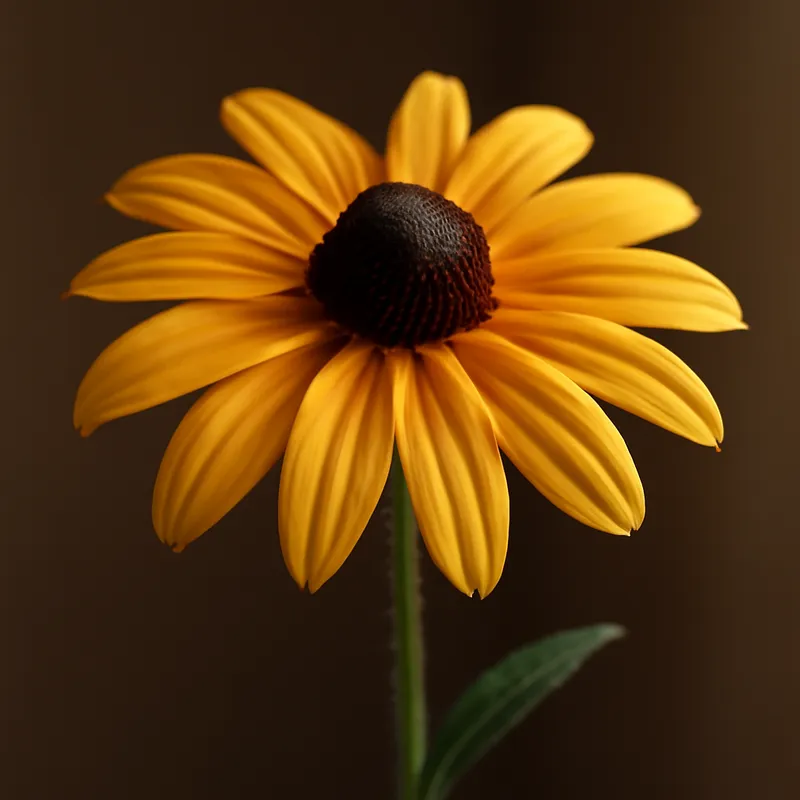


Golden daisies with dark centres
Rudbeckia is a North American genus, and the gold-and-black flowers have become a staple of British gardens. Each flower has yellow ray petals around a raised dark cone, which is why plants such as Rudbeckia hirta are known as black-eyed Susans. The genus is named after the Swedish Rudbeck father and son, botanists who taught Linnaeus.
Species in British gardens
- Rudbeckia fulgida var. sullivantii 'Goldsturm' is a reliable perennial that flowers from late July to October.
- Rudbeckia hirta is short-lived, often grown as an annual, with many shades of yellow, orange and bronze.
- Rudbeckia laciniata 'Herbstsonne' is a tall perennial up to about 2 m, with drooping petals and a green cone.
Not the same as echinacea
Echinacea, often called coneflower, is a different genus. Its petals are generally pink-purple and droop, and its centre is spiky orange-brown. Rudbeckia has yellow to orange ray petals, with a dark central cone.
Growing rudbeckia
- Plant in full sun, or light shade, in moisture-retentive soil.
- Perennial types do well on heavier clay, but water in dry spells in the south-east.
- Watch for slugs and snails on young shoots in spring and for powdery mildew in late summer.
- Divide clumps in spring every three or four years.
- Plant in spring or early autumn, in groups of three or five.
Seedheads and wildlife
Leave the dark seedheads over winter, since they give structure when frost sparkles on them and goldfinches will visit for seeds. Bees and hoverflies visit the open flowers in August and September. Rudbeckia is a favourite in naturalistic prairie plantings, often paired with ornamental grasses.
Stems last about a week in a vase, and the ASPCA lists black-eyed Susan (Rudbeckia hirta) as non-toxic to dogs, cats and horses.